
What Happens on a Plant Maintenance Visit
Most St. Louis businesses that contact us about professional office plant installations ask versions of the same two questions. The first is about the installation: what plants, what positions, what containers, what it will look like. The second, asked less often, but just as important is about what happens after: what does maintenance actually involve, and what are we committing to?
This post answers the second question in full. Because the installation is the starting point, not the product. The product is a space that looks as good in month eighteen as it did on installation day and that outcome is entirely determined by what happens on every maintenance visit in between.
Why Maintenance Matters More Than Most Clients Expect
The research on the benefits of office plants, the productivity gains, the stress reduction, the improvements to perceived air quality, is almost entirely based on healthy, thriving plant environments. Washington State University research on indoor plants and productivity documented that workers in plant-enriched environments were 12% more productive and reported lower stress — but the study used live, well-maintained plants in good condition. A declining installation does not produce the same effects. In some cases it produces the opposite: a space that signals neglect rather than care.
A Journal of Physiological Anthropology study on plants and stress reduction found that interaction with indoor plants measurably suppressed sympathetic nervous system activity — the physiological stress response — compared with computer task conditions. That effect depends on plants that are genuinely healthy. Yellowing leaves, dropping foliage, and dried-out soil do not produce the same neurophysiological response as thriving greenery.
Professional maintenance is what keeps the installation in the condition that produces those benefits. And professional maintenance is not watering on a schedule. It is a systematic assessment of every plant in your space on every visit.
What We Assess on Every Visit: The Full Checklist
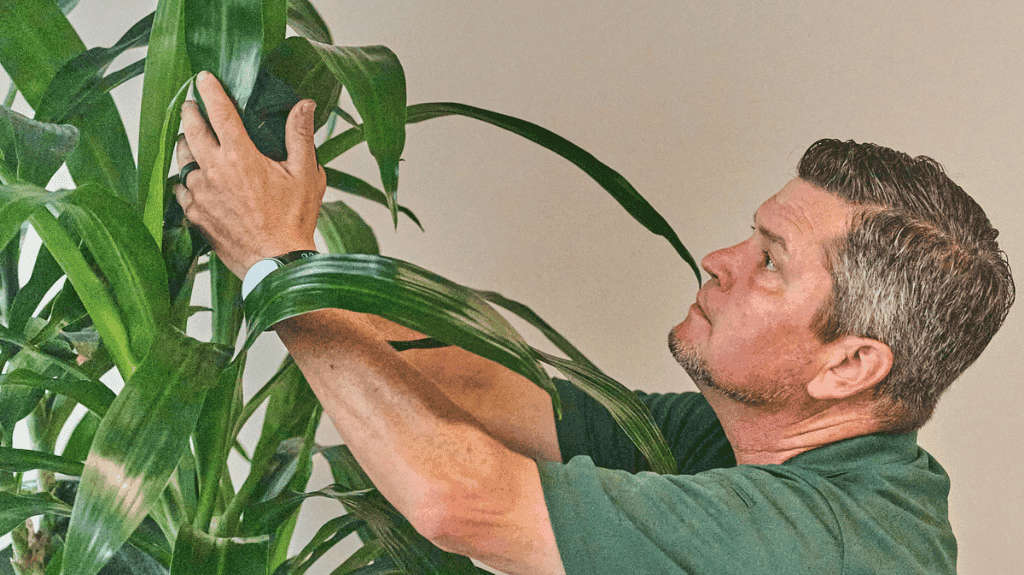
When a Tropical Décor horticulture technician arrives at a St. Louis office for a scheduled maintenance visit, the first thing they do is not water. The first thing they do is look. Every plant in the installation is assessed visually before anything is touched. Here is what that assessment covers.
Leaf condition is the primary health indicator for every plant. A trained eye reads leaves the way a doctor reads a patient: yellowing on older leaves in a ZZ plant means something different from yellowing on new growth. Brown leaf tips on a pothos indicate low humidity or fluoride accumulation in the soil, not underwatering — which means watering more would make the problem worse, not better. Spotting on a peace lily suggests a different issue entirely. The specific pattern of any leaf problem tells us what is causing it and what the correct response is. Generic watering services do not read these patterns. They water and leave.
Soil moisture is assessed by hand, not by schedule. Different plant varieties have different moisture requirements. A ZZ plant in a shaded corner of a Chesterfield office retains moisture very differently from a bird of paradise in a south-facing window in a Clayton high-rise. Watering on a fixed schedule regardless of actual soil condition is one of the primary drivers of plant failure in professionally serviced installations where the service provider is not genuinely assessing moisture before watering.
Root and container condition is checked at regular intervals — not every visit, but on a rotation. Roots emerging from drainage holes, soil pulling away from container edges, or unusual weight changes in a pot can all indicate that a plant needs repotting. Catching this early prevents the stress response that occurs when a plant becomes severely root-bound.
Pest presence is assessed on every visit. Early-stage pest problems — spider mites, fungus gnats, scale insects — are nearly invisible to an untrained eye and easily treatable when caught early. Left unaddressed, they spread to adjacent plants and become significantly more difficult to manage. In a professionally maintained installation, pest issues are almost always caught and resolved before they become visible to anyone in the office.
Position and light assessment is conducted seasonally. As we have written previously about the summer and fall light changes in St. Louis offices, the conditions in a given position change significantly across the year. A plant that is correctly positioned in September may need to move by November as the sun angle drops and interior light levels decrease. Our technicians make these adjustments as part of regular maintenance — not in response to a phone call after the problem is visible.
What We Do on Every Visit: The Active Care Component
After the assessment, the active care work begins. This varies by plant, by season, and by what the assessment reveals, but the standard components of every visit include the following.
Watering is calibrated to what the assessment shows, not to a predetermined schedule. The amount, the method, and in some cases the type of water used.
Leaf cleaning is performed on every visit for varieties where dust accumulation is a concern. Dust on leaf surfaces reduces photosynthetic efficiency — plants covered in dust cannot process light as effectively as clean-leafed plants. In a St. Louis office environment, particularly one with a forced-air HVAC system running year-round, dust accumulation on large-leafed varieties like fiddle leaf figs, bird of paradise, and peace lilies is significant enough to affect plant health over time if not addressed regularly. Clean plants also look measurably better, which matters in a client-facing environment.
Pruning and deadheading is done as needed on every visit. Removing dead or dying leaves immediately, trimming leggy growth before it affects the shape of a plant, and deadheading spent flowers on peace lilies and other flowering varieties all contribute to an installation that looks designed and cared for rather than left to grow however it wants.
Fertilization is applied on a seasonal schedule calibrated to the growth cycles of each variety. Most plants benefit from fertilization during their active growing seasons in spring and summer and require little or none during the lower-light, slower-growth period of a St. Louis winter. Over-fertilization is a common problem in DIY installations — it accelerates growth beyond what the light conditions can support, producing weak, leggy plants that do not hold their form.
When We Replace a Plant — and Why That Decision Matters
One of the most important things professional maintenance includes — and one of the least understood by prospective clients — is replacement. When a plant is not performing as it should, whether due to irreversible pest damage, disease, root failure, or simply a gradual decline that has not responded to corrective care, we replace it. The replacement is included in the maintenance relationship. You do not receive an invoice for a new plant because one failed.
This matters because replacement decisions require judgment. The question is not just whether a plant looks bad today, but whether the underlying cause is reversible. A peace lily that is wilting because it missed a watering visit will recover fully within hours of being watered — it does not need to be replaced. A ZZ plant that is yellowing because of root rot caused by a drainage failure is not going to recover regardless of intervention and should be replaced promptly before the condition spreads to adjacent plants. Making that call correctly requires the kind of horticulture expertise that comes from managing plant installations professionally across many years and many environments.
A ScienceDirect systematic review on indoor plants and office wellbeing synthesized findings across multiple studies on office plant environments and found that the positive effects on employee wellbeing, cognitive performance, and satisfaction were associated with well-maintained, healthy plant installations — not simply with the presence of plants in any condition. The maintenance standard is what determines whether an installation delivers the benefits the research documents.
What This Means for Your St. Louis Office
When Tropical Décor installs and maintains plants in a St. Louis office, the ongoing maintenance relationship is not an add-on to the installation. It is the delivery mechanism for everything the installation is intended to produce. The aesthetics, the first impression, the employee wellbeing effects, the client perception — all of these depend on plants that are genuinely healthy and well-maintained, not just present.
Our maintenance visits are conducted by trained horticulture technicians who know the specific plants in your installation, the specific conditions of your space across seasons, and the specific history of every plant under our care. That continuity — the same technician, the same knowledge base, the same relationship with your space over time — is what makes the difference between an installation that looks spectacular for six months and one that looks spectacular for six years.
Explore our office plants to understand which varieties are part of our St. Louis installations, and visit our plant maintenance services page for a full overview of what the ongoing relationship includes. If you are ready to talk about your specific space, a free consultation is the right starting point.
Ready to understand exactly what you would be getting? Schedule a free consultation — we will walk your space, explain the full maintenance process, and show you what a professionally maintained installation looks like over time.
